
Lecture Review|William Hubbard: AI in the Legal Profession and Legal Education
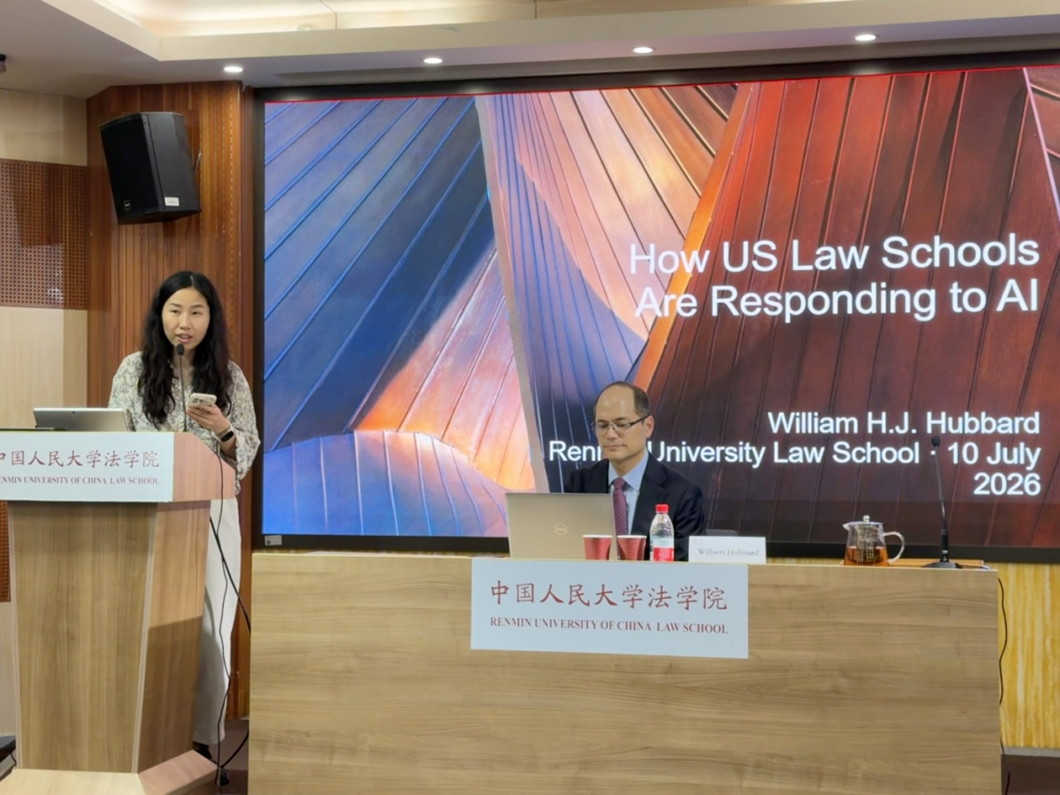
time:2026-07-16On July 10, 2026, the academic lecture entitled AI in the Legal Profession and Legal Education was held in Room 602, Mingde Law Building. Hosted by the Law School and Renmin Law and Technology Institute of Renmin University of China, this lecture marked the 94th session of the Frontier Forum for Future‑Rule‑of‑Law and Digital Law, and the 36th lecture of the Global Distinguished Chair Lecture Series. Professor William Hubbard, Vice‑Dean of the University of Chicago Law School, was invited as the keynote speaker. Associate Professor Peng Yali from the Renmin University of China Law School moderated the lecture. Professor Dai Xin, Tenured Associate Professor and Vice‑Dean of Peking University Law School; Professor Ding Xiaodong, Vice‑Dean of the Renmin University of China Law School; Professor Wang Ying, Deputy Director of the Renmin Law and Technology Institute of Renmin University of China Law School; and Professor Zhang Jiyu, Executive Director of the Renmin Law and Technology Institute of Renmin University of China Law School, served as discussants (listed in alphabetical order of Chinese surnames). The event was co‑organised by the Digital Law Teaching and Research Center of the Law School, the MOE Philosophy and Social Sciences Innovation Team “New‑Tech Revolution and Future‑Rule‑of‑Law Innovation Team”, and the International Association of Digital Law.
Lecture Review:
Professor Hubbard drew on the newly‑released artificial intelligence strategy of the University of Chicago Law School to systematically analyse the structural changes brought by generative artificial intelligence from three dimensions: the legal profession, legal education and legal research. At the level of the legal profession, he remained cautious about the proposition that AI will “directly replace lawyers”. Technology is more likely to redistribute work contents and reshape competence structures, rather than simply eliminate the legal profession. In terms of legal education, U.S. law schools have generally developed four policy approaches in response to AI’s penetration into campus environments. The University of Chicago Law School has put forward its “Both‑and‑None” dual‑path strategy and carried out a series of relevant reforms. Professor Hubbard summarised these reforms under three concepts: AI‑resilient pedagogy, effective and ethical AI use, and the essential human dimension of law. For legal research, Professor Hubbard predicted that AI will substantially cut the costs of writing and material collation, fueling a sharp rise in the total output of papers and correspondingly raising academic institutions’ expectations for researchers’ productivity. Nevertheless, higher output quantity does not equal improved quality. Artificial intelligence also gives rise to new divides over academic ethics. Regarding the issue of originality, Professor Hubbard put forward a “paradox effect”: artificial intelligence may increase the absolute number of good ideas, yet lower the average quality across all outputs.
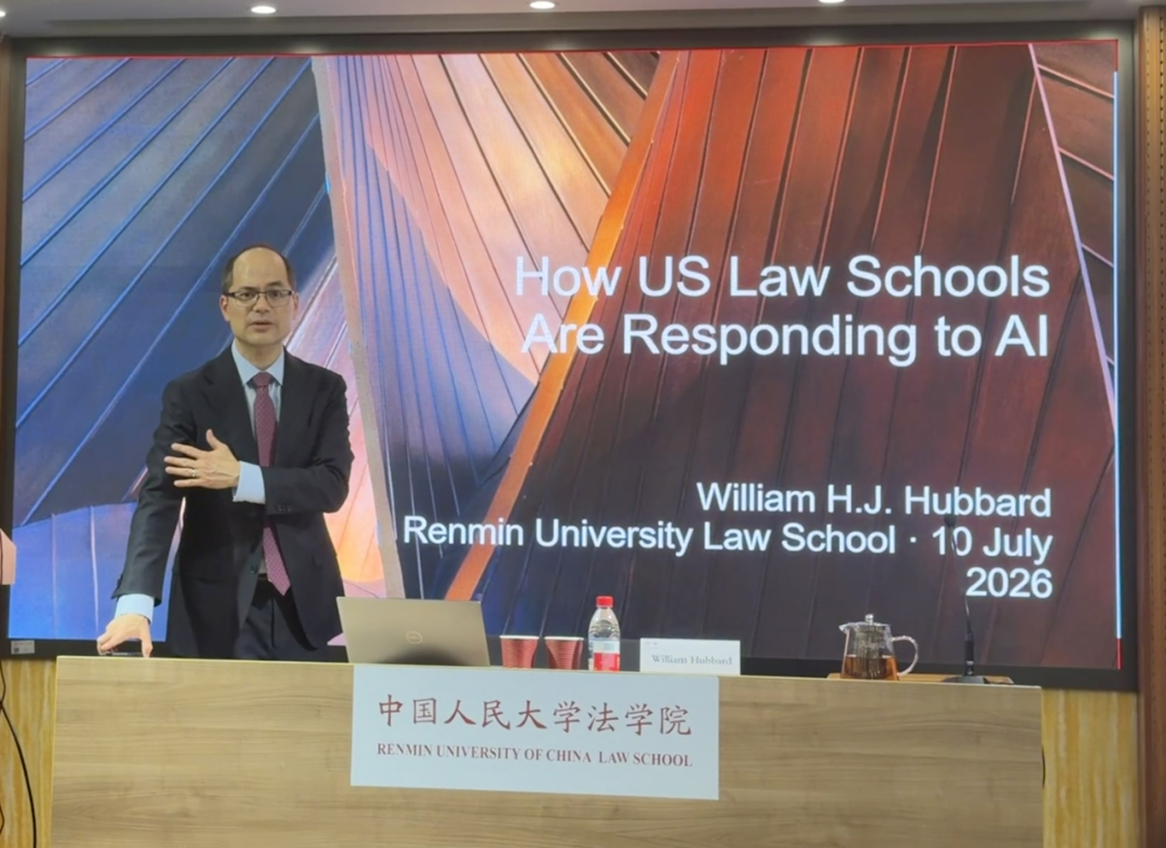
Professor William Hubbard, Vice‑Dean of the University of Chicago Law School
Discussants Comments:

Professor Dai Xin, Tenured Associate Professor and Vice‑Dean of Peking University Law School
Vice‑Dean Dai Xin drew on surveys of AI‑related teaching policies conducted by Peking University Law School and pointed out that responses to artificial intelligence among Chinese and U.S. law schools remain confined to measures such as outright prohibitions, instructor‑discretionary rules or the addition of specialised courses. Most institutions have not yet systematically restructured traditional teaching. He raised questions concerning strengthened communication training, tiered training objectives, and the feasibility of device‑use bans. Professor Hubbard responded that writing training is irreplaceable. Debates over tiered training for law schools have already emerged in the United States, and pushback against device bans has been lower than anticipated.

Professor Wang Ying, Deputy Director of the Renmin Law and Technology Institute of Renmin University of China
Professor Wang Ying probed the connotation of legal originality against the backdrop of the civil‑law system, questioning whether conceptual construction in doctrinal research could be simulated by models. Professor Hubbard contended that originality will grow more valuable as it becomes scarcer.

Professor Zhang Jiyu, Executive Director of the Renmin Law and Technology Institute of Renmin University of China
Professor Zhang Jiyu explored the boundaries of appropriate AI usage, focusing on risks of capability degradation and the refinement of rules. Professor Hubbard emphasised that rules should be tailored to individual course objectives, with benchmarks gradually clarified through practical implementation.

Professor Ding Xiaodong, Vice‑Dean of the Law School of Renmin University of China
Vice‑Dean Ding Xiaodong observed that Chinese law schools feature dense course schedules and fragmented learning patterns, making straightforward transplantation of U.S. experience inappropriate. Professor Hubbard suggested prioritising quality over quantity by reducing workloads, shrinking class sizes and restoring in‑depth interaction, regarding this as an opportunity to reshape educational models.
Q&A with Faculty and Students:
During the Q&A session, one student asked how AI‑related courses can avoid obsolescence amid rapid technological iteration. Professor Hubbard pointed out that curricula should not focus on specific tools or prompt‑engineering techniques, but rather cultivate critical judgment and sound professional ethics. Another student drew on stringent AI‑powered paper reviews to question whether existing academic‑evaluation criteria are flawed. Professor Hubbard contended that the core of evaluation lies in raising meaningful questions and producing useful knowledge, not in achieving perfection. Nevertheless, the surge in submissions driven by AI may lead editors to rely on non‑quality signals such as reputation, or deploy AI for initial screening. Caution should be exercised against the risk of narrowing the scope for unconventional ideas. Moreover, another student inquired why the essential distinction between humans and technology has been repeatedly questioned since the advent of AI, whereas earlier technologies did not trigger comparable concerns. Professor Hubbard responded that AI is encroaching upon human capacities for language, writing and reasoning. Even so, each individual’s unique subjective experience, identity and interpersonal relationships remain irreplaceable human values, which constitute the very foundation of law as a human‑centred profession.
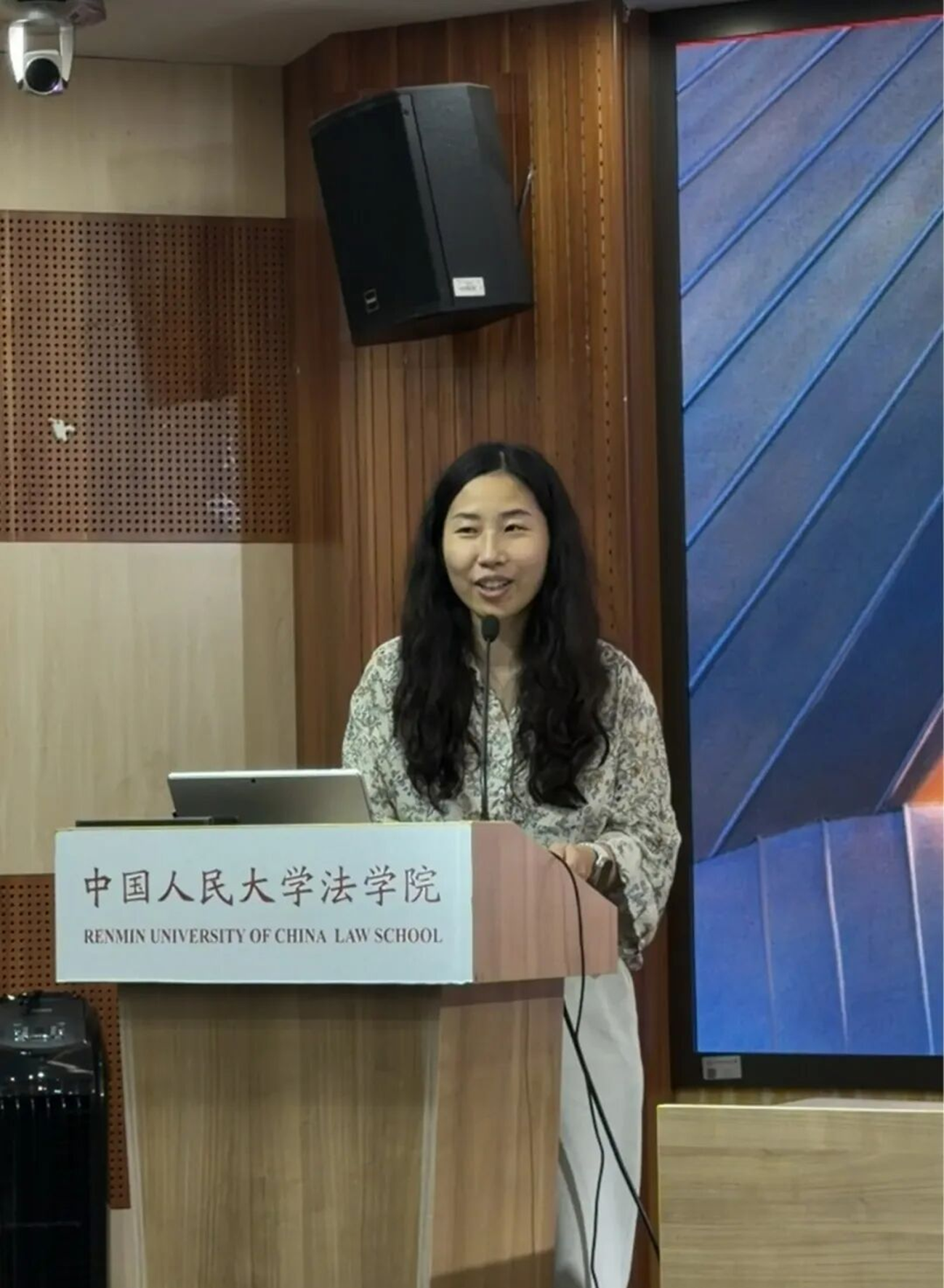
Associate Professor Peng Yali, Renmin University of China Law School
Associate Professor Peng Yali stated in her closing remarks that this lecture not only illustrated the institutional responses of the University of Chicago Law School to artificial intelligence, but also advanced the discussion to fundamental issues including the purposes of legal education, scholarly originality and human subjective value. In the AI era, in‑person academic exchanges, genuine human connections and open‑minded cross‑border dialogues are particularly precious. She expressed her gratitude to Professor Hubbard for his insightful presentation, as well as to all discussants and students for their in‑depth discussions.
The lecture concluded amid warm applause.
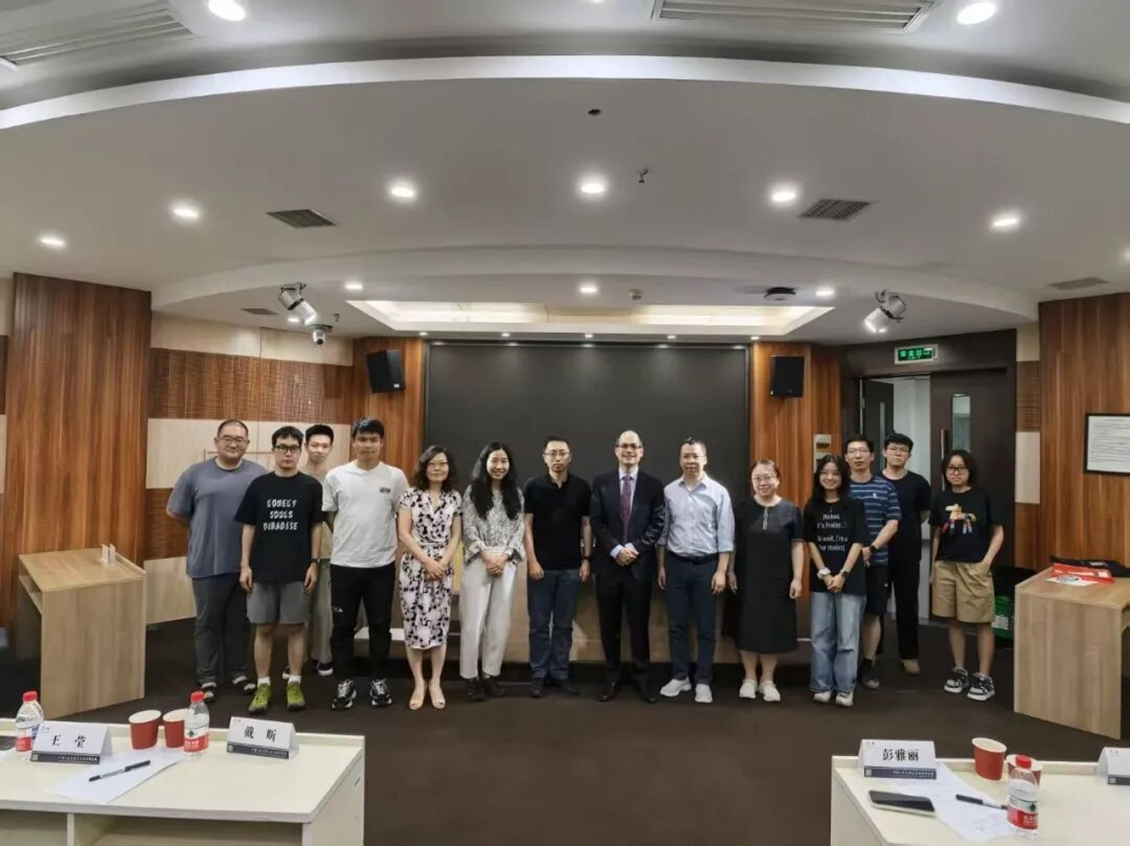
Faculty‑Student Group Photo