
Review of the Second Renmin University of China–Seoul National University Academic Conference for Young Legal Scholars
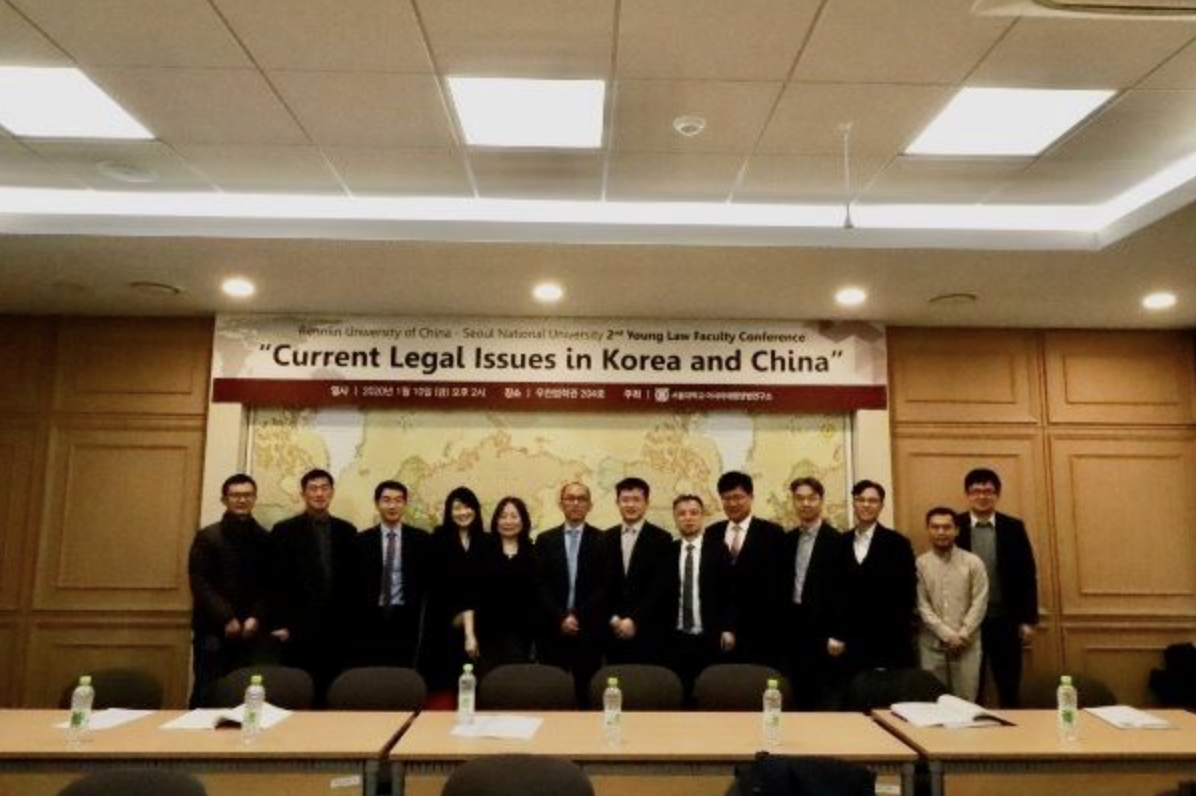
time:2020-03-20On January 10, 2020, the Second Renmin University of China–Seoul National University Academic Conference for Young Legal Scholars was held at the Law School of Seoul National University in the Republic of Korea. Professor Meng Yanbei, Associate Professor Xiong Bingwan and Assistant Professor Jin Yin from our Law School attended the conference. The participating faculty members from the Law School of Seoul National University included Professor Haksoo Ko, Professor Guangwen Jiang, Professor CHON Jong-ik, Professor Woo-Young Rhee, Professor Kyung-Hoon CHUN, Professor Kye Joung Lee, Professor Dongjin Lee and Professor WU Ying-Chieh. The conference conducted in-depth deliberations on a number of significant issues arising in the ongoing rule-of-law development of China and the Republic of Korea.
Professor CHON Jong-ik presided over the opening ceremony. On behalf of the Law School of Seoul National University, Professor Haksoo Ko delivered an opening address. He extended a warm welcome to the visiting delegation from the Renmin University of China Law School, spoke positively of the academic exchange mechanism for young legal scholars jointly initiated and established by the two law schools, and highly affirmed the academic value of the research topics scheduled for discussion at this conference. Professor Meng Yanbei delivered an address on behalf of the Renmin University of China Law School. Professor Meng recapitulated the successful convening of the first Renmin University of China–Seoul National University Academic Conference for Young Legal Scholars hosted by the Renmin University of China Law School in early 2019. She spoke highly of the fruitful exchange outcomes and promising development prospects achieved by legal scholars from both institutions via this academic platform, and expressed the expectation that this mechanism would facilitate exchanges of theoretical doctrines and practical experience regarding the shared rule-of-law challenges faced by both countries at present.
Professor Meng Yanbei presided over Session One. Professor Woo-Young Rhee presented a report entitled Korea's Prosecutorial Reform Discussion from the Constitutional Perspective. Starting from Korea’s existing prosecutorial organizational framework and criminal prosecution procedures, and drawing on various statistical data of prosecutorial cases, she analyzed the performance of Korea’s current prosecutorial system in effective prosecution and wrongful prosecution of criminal suspects, with a particular focus on the abuse of prosecutorial power arising from insufficient supervision and checks within the existing prosecutorial regime. She proposed that Korea should revise its current criminal prosecution system based on constitutional norms, so as to deliver effective protection for citizens’ fundamental rights and the legitimate interests of vulnerable groups.
Associate Professor Xiong Bingwan delivered a presentation titled License as Property: the Key to Unlock the Regulatory Dilemma of Non-professional Taxi Markets. He analyzed the regulatory deadlocks emerging in the formulation and enforcement of online car-hailing regulatory policies across more than one hundred cities in China. Combining statistical data and field investigations of sampled cities, he elaborated on the underlying drivers of divergences in regulatory policies among these jurisdictions. He argued that the core to resolving deadlocks in online car-hailing regulation lies in restructuring the property rights framework governing operating licenses within the traditional taxi industry. He also expressed the hope that such research findings could facilitate the comprehension and optimization of taxi regulatory policies in other jurisdictions.
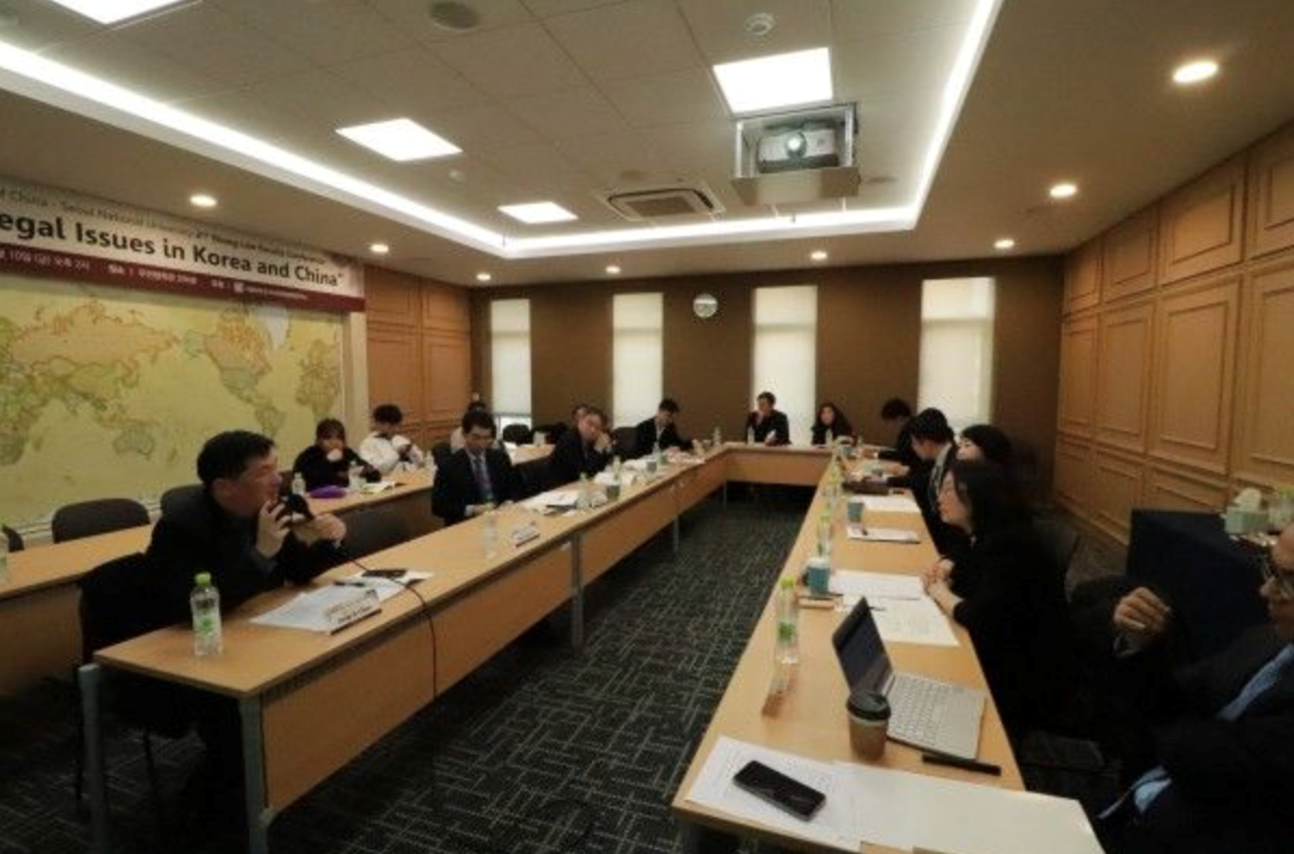
Professor Kye Joung Lee presided over Session Two. Assistant Professor Jin Yin delivered a presentation entitled The Standoff between the Out-of-Court Settlement during the Second Instance and the First Instance Judgement: An Example that Indicates the Deficiencies of the China Guiding Cases Project. He first outlined the core facts of Guiding Case No. 2 and put forward his academic viewpoints on the normative conflict between out-of-court settlements reached in second-instance proceedings and judgments rendered at the first instance. After statistically sorting out and analyzing all 121 guiding cases issued by the Supreme People’s Court across 21 batches, he contended that virtually no additional guiding cases centered on second-instance out-of-court settlements have been released thereafter. Accordingly, the defects embedded in Guiding Case No. 2 can hardly be rectified through subsequent institutional arrangements.
Thereafter, Professor Dongjin Lee delivered a presentation entitled Unfair Terms Regulation in Standard Form Contract: between Contract and Competition Law. He carried out a comparative analysis of various validity review mechanisms governing standard contract clauses, such as mandatory prohibitions by competent administrative authorities, blanket invalidation of unfair clauses, vesting contracting parties with the right of revocation, and market competition mechanisms. He also commented on the problems of under-regulation and over-regulation that may arise under each of these regulatory approaches. He contended that differentiated regulatory mechanisms for standard terms ought to be applied in light of specific factual contexts, so as to realize the socially optimal allocation of standard form contracts.
After more than three hours of in-depth academic exchanges, the conference drew to a successful close. In their closing addresses, Professor Haksoo Ko and Professor Meng Yanbei highly commended the cutting-edge nature of the research topics presented and discussed by scholars from both sides, as well as the originality of their analytical methodologies. They praised the substantial academic outputs yielded through thorough bilateral dialogue and expressed the expectation that scholars of both law schools would generate further valuable research achievements relying on this long-term exchange platform.
Editor:Xu Liuya
Reviewer: Zhu Peiwen